Execution Excellence in Construction: A Practical Path to Future-Ready Project Delivery
Productivity in construction is often discussed but rarely measured accurately, and even less frequently improved in a structured manner. Many project leaders recognize that performance is lacking, yet the specific reasons for lost time and effort often remain unclear. Visible symptoms include delays, firefighting, and rework. However, the root causes are typically embedded in everyday practices, planning gaps, and coordination breakdowns that go untracked.
At the core of Lean Construction lies a deceptively simple question: Where is the waste? Projects often lose time, energy, and coordination due to avoidable issues such as waiting, overprocessing, rework, unnecessary movement, and other non-value-adding activities—collectively known as the eight wastes of Lean.
Our objective with execution excellence is to make these wastes visible, measurable, and reducible—step by step—through structured planning, improved decision-making, and daily coordination. This is where execution excellence makes a difference. It is not just a buzzword but a practical system that provides structure, visibility, and capability to everyday project delivery.
What Is Execution Excellence?
Execution excellence is the consistent ability to deliver construction projects with predictability, productivity, and control, without compromising on quality, safety, or collaboration.
- Constraint-aware, realistic planning
- Stronger collaboration between disciplines and departments
- Faster issue identification and resolution
- Visible routines that align daily actions with project goals
- Ownership and decision-making at the site level
It's not a one-time intervention or a report from an external advisor. It's a way of working—built into daily routines, team interactions, and cross-functional workflows. At its core, it enables:
A Structured Framework for Project Success
Execution excellence doesn't emerge by accident. It must be designed, implemented, and improved through deliberate actions. Based on our experience, the journey typically follows five structured phases:
Advisory and Assessment
A project health check to identify pain points, planning gaps, and opportunities to improve coordination. This forms the foundation for a targeted improvement roadmap.
Training and Setup
Real-world training sessions—tailored to functional teams—introduce tools like collaborative planning, constraint management, and visual workflows. These are not theory sessions but grounded in actual site conditions.
Implementation and Coaching
Teams adopt new planning and coordination routines with active support and facilitation. This includes daily huddles, weekly planning, and structured issue resolution—building habits through repetition and reinforcement.
Run and Review
As routines take shape, ongoing coaching, dashboard reviews, and periodic clinics help maintain momentum. Progress is tracked through planning reliability, issue logs, and team feedback.
How We Make It Happen: Tools and Practices
Execution excellence is driven by the right blend of Lean Construction principles and practical Project Management methods, applied directly at the site level. We use a range of proven tools, including:
Last Planner System®
Collaborative planning at quarterly, monthly, weekly, and daily levels to align teams, manage constraints, and track work reliability.
Value Stream Mapping and Work Observation
Visualising where time is lost between tasks or during handovers—and using this to guide improvement.
Interface Management
Addressing coordination gaps between internal functions and subcontractors to avoid scope overlaps and delays.
Lean Problem Solving
Using A3s, PDCA cycles, and root cause analysis to resolve—not repeat—issues.
Continuous Improvement Practice
Turning lessons from daily work into structured learning, shared across teams and projects.
Measuring Progress (A Practical Maturity Matrix)
A practical maturity model based on Govern–Map–Measure–Manage (GMMM) to track progress and identify improvement priorities.
Information Transparency and Big Room Thinking
Creating shared visibility through visual boards, open issue logs, and cross-functional dashboards.
Depending on the project context, other Lean tools such as 5S (workplace organisation), SMED (quick changeover), and poka-yoke (error-proofing) may also be introduced—particularly in precast, MEP, or equipment-heavy workstreams. These tools support reliability, safety, and flow when applied with clear purpose.
Quick Wins That Build Momentum
Early in any project, a few high-impact routines can create immediate traction. These small wins build trust, create clarity, and set the stage for deeper transformation.
Look-ahead Planning
Two-week look-ahead plans and constraint logs
Daily Huddles
Daily huddles with visual task tracking
Site Observations
Site walk observations focused on productivity blockers
Reliability Metrics
Plan reliability metrics (PPC)
Delay Analysis
Delay logs categorised by root cause
Interface Mapping
Interface maps between trades and departments
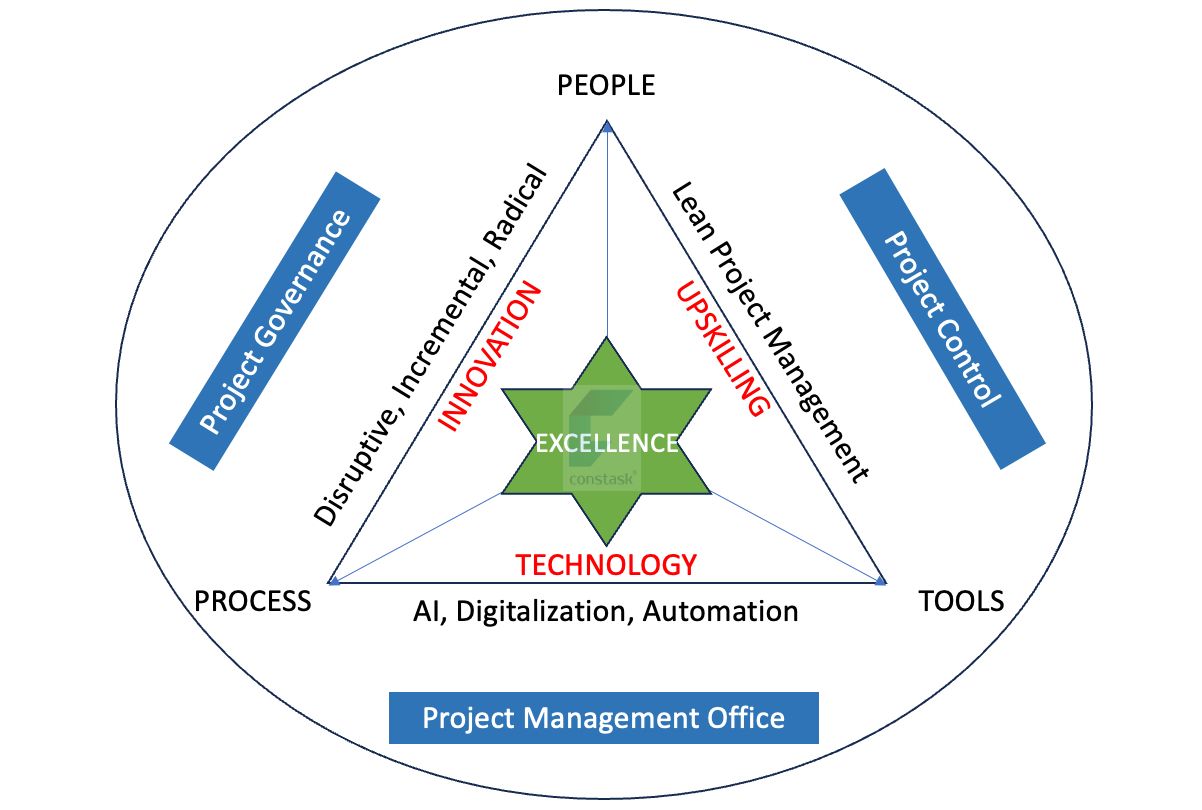
People–Process–Tools: A Steady Path to the Future
True transformation begins with people. Lean helps project teams build awareness, structure, and capability. From there, better processes emerge—and the right tools can be selected or adapted accordingly.
Trying to automate or digitalise without this foundation often leads to resistance or underused systems. With a Lean-based continuous improvement mindset, organisations can:
- Prioritise what to digitise, automate, or enhance with AI/robotics
- Reduce change resistance by involving teams in decision-making
- Build internal clarity on what adds value—and what doesn't
- Shift from reactive firefighting to structured execution
None of this works without a shift in leadership mindset. Execution excellence relies on Lean leadership—leaders who enable their teams, guide improvement cycles, and support learning from failure rather than reacting to it.
Focused coaching and reflection sessions help individuals and teams grow into this mindset, creating alignment between strategic intent and operational behaviour.
Future-Ready Project Teams Start Now
Implementing new routines in live projects is not always easy—especially with legacy systems, existing contracts, or cultural resistance. That's why change management is embedded into our approach. We work with site teams and leadership to identify what's practical, what can co-exist with current systems, and how to ensure that changes are absorbed without overwhelming the team.
The industry is moving toward Integrated Project Delivery, data-driven decision-making, and digitally-enabled execution. But the leap begins with strengthening daily coordination, improving flow, and creating a culture that learns and adapts.
Execution excellence provides that bridge—from today's challenges to tomorrow's performance. Execution excellence also helps improve a project's resilience—its ability to adapt to disruptions. Early identification of execution risks, better visibility of constraints, and real-time team engagement support scenario planning, faster response, and reduced downtime.
If you're looking to bring structure, visibility, and improvement into your projects—start not with a system, but with your project teams. That's where excellence begins.
Looking to improve execution on your construction projects?
Contact us at contact@constask.com for a free 45-minute consultation or learn more about our Business and Execution Excellence services.